
Tunnel kiln delamination of PV modules
A tunnel kiln does continuously what a batch oven does slowly: it carries frameless laminates through a controlled temperature profile and drives the

Laminates travel on carriages through zones held at different temperatures: preheat, delamination, a hold to complete the removal across the full area, controlled cooling, and discharge. The encapsulant and backsheet are driven off as vapour, which is extracted and treated; the glass leaves able to be graded rather than carrying polymer residue.

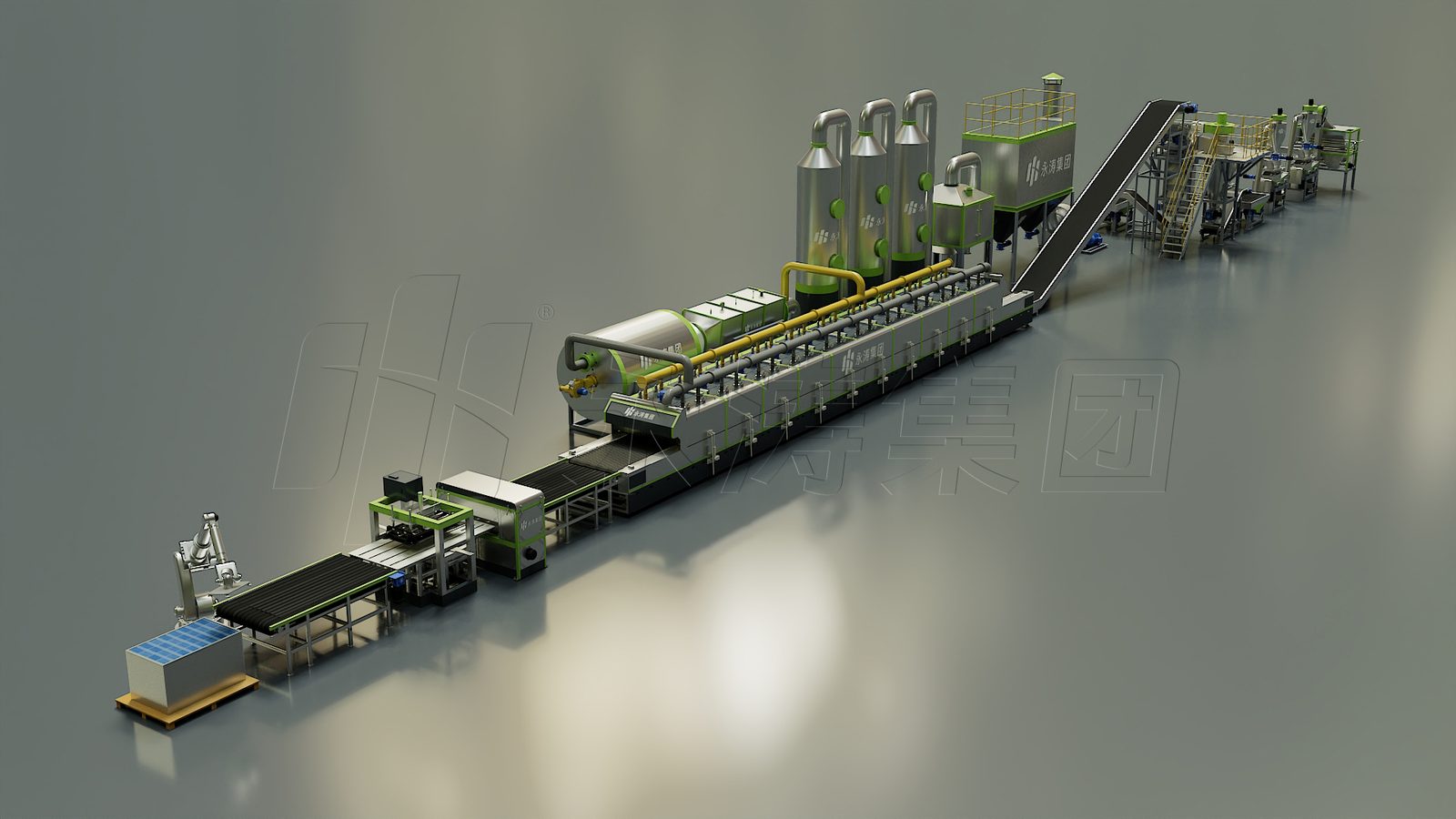
As the laminate softens, a pane supported only at its edges sags and cracks. A pane resting on a solid tray does not see even airflow. A fixture that holds the module too rigidly cannot accommodate the differential expansion between the glass and its surroundings.
We treat the carriage fixture as a designed part of the project, sized to your module format and confirmed against your feedstock. Plants that get the kiln right and the fixture wrong get inconsistent glass and blame the temperature profile.
A tunnel kiln performs best on consistent laminates. Tell us your module formats and how uniform your feed is, and we will tell you whether continuous delamination suits it.
A tunnel kiln is continuous and optimised for flat frameless laminates, with the polymer driven off as off-gas. A pyrolysis plant runs batch or continuous on more varied dismantled material and recovers the polymer as oil and gas. The choice follows from your feed and from whether the oil has a use.
Yes. The frame is removed on the deframing machine so the aluminium is recovered as a clean metal stream. Sending framed modules to a kiln wastes that value and contaminates the residue.
The temperature profile and the carriage fixture. Fixture design is the more frequently underestimated of the two — edge-only support will crack panes as they soften.
It is configured to your permit and included in the scope as a line item. Continuous thermal operation produces a continuous off-gas, so extraction and treatment are part of the project rather than an accessory.
Tell us what arrives at your gate and what has to leave. The engineering team replies with the station configuration, the scope boundary and the information still missing before drawings start.
Prefer to talk first? WhatsApp +86 182 0399 3035 or email [email protected].
Three details are enough to start: what modules you receive, how fast you need to process them, and what output you have to produce.