
Solar panel recycling equipment, from a single machine to a complete front end
Six pieces of equipment cover the whole dismantling front end. Most projects start with one of them and grow, so each unit is designed to sit inside a

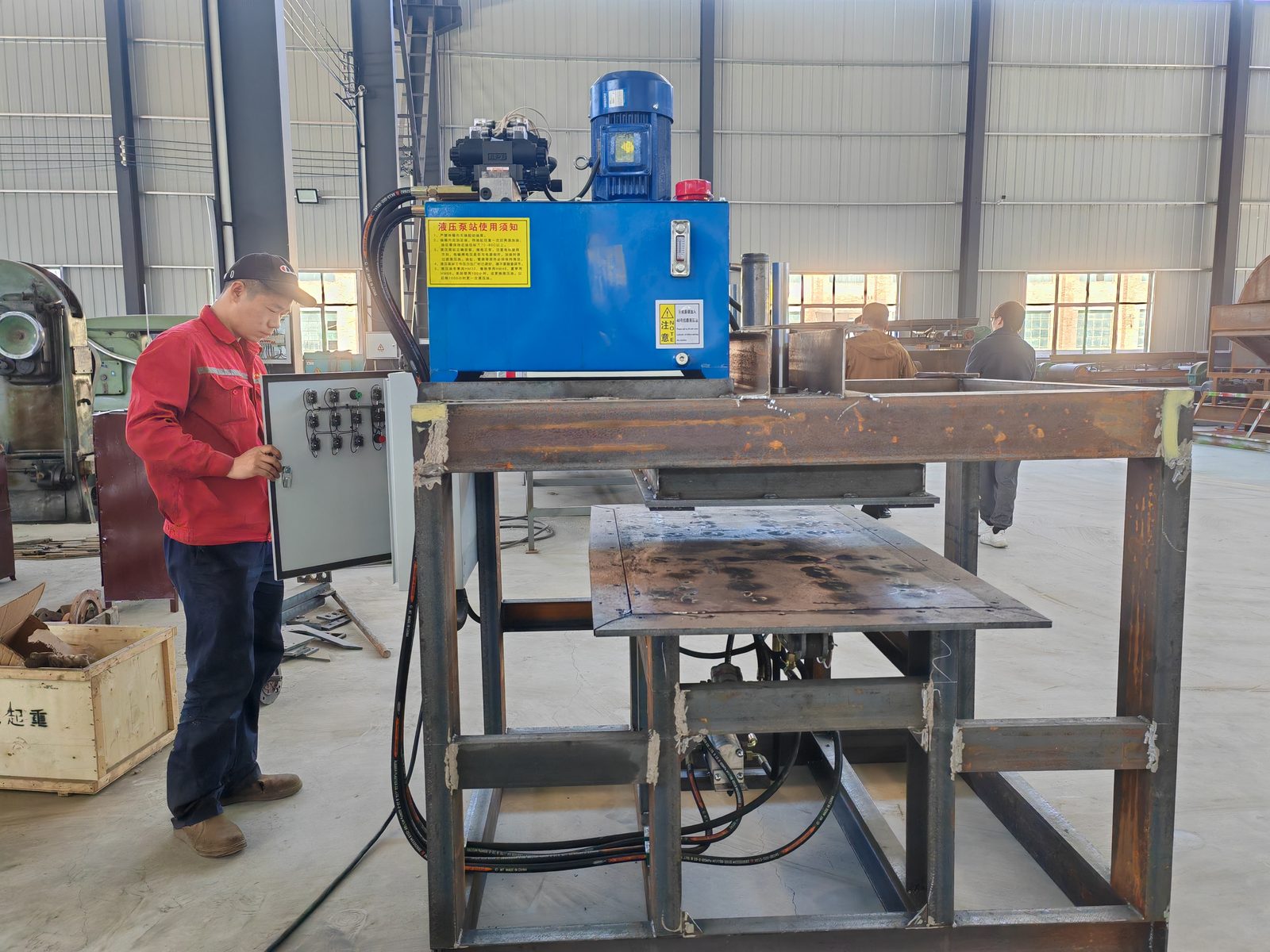
The machine removes the aluminium frame from a framed PV module before anything else is done to it. That order matters: the frame is the highest-value single component in the module, and it is also the part most likely to damage the glass stream if it is left on. Removing it intact is what keeps the aluminium saleable and the glass clean.
The module is loaded and squared by pneumatic positioning clamps. The cutting head releases the frame legs. The press closes and opens to free the frame from the laminate, and the frameless laminate leaves the machine for the next station.
| Phase | Duration | What is happening |
|---|---|---|
| Operator loading | ≈ 5 s | Module placed against the stop and released to the machine |
| Positioning and frame cut | ≈ 30 s | Pneumatic clamps square the module; the cutting head releases the frame legs |
| Upper press | ≈ 5 s | Press closes to free the frame from the laminate |
| Lower press | ≈ 5 s | Press opens and releases the module |
| Total machine cycle | ≈ 45 s | One module per minute including loading |
| Rated through-put | 1 t/h | As stated in the equipment brief |
The cycle figures come from the machine's own equipment brief. Achieved hourly tonnage depends on the average mass of the modules in your feedstock, and on how consistently they are presented to the machine.

| Function | Removal of the aluminium frame from framed PV modules |
| Through-put (published brief) | 1 t/h |
| Cycle | One module per minute |
| Machine processing time | ≈ 45 seconds per module |
| Height | 2.5 m |
| Width | 2.23 m |
| Transport | Envelope sized for standard container loading |
| Positioning | Pneumatic clamps with four positioning cylinders |
| Frame release | Cutting head plus upper and lower press |
| Hydraulic press setting | Adjusted and commissioned in our works before dispatch |
| Wear parts | Chain and sprocket, four positioning cylinders, positioning rubber |
| Feedstock limits | Confirmed against your module mix at quotation stage |
Four items are identified as consumables on this machine: the chain and its sprocket, the four positioning cylinders, and the positioning rubber that squares the module. Chains are a standard industrial size and can typically be sourced locally if you prefer not to wait for a shipment; the cylinders and positioning rubber are the parts we recommend keeping as spares from the start.
The upper hydraulic press unit is adjusted and commissioned in our works before dispatch, and the equipment brief is explicit that this setting should not be altered casually on site — if your process genuinely requires a different setting, that change should be made by an engineer.


| Good fit | Not the right machine |
|---|---|
| Framed crystalline-silicon modules, poly and mono | Frameless or glass-glass modules — there is no frame to remove |
| Operators currently deframing by hand | Feedstock that is largely thin film — containment matters more than frame recovery |
| Plants that want clean aluminium and clean glass | Sites expecting a shredder to do the separation work |
| Mixed vintages, provided frames are dressed square first | Severely bent or detached frames, which are usually better handled manually |
| Plants planning to add glass removal next | Projects with no defined output specification for the glass stream |
Send the module type, frame profile, how much of the feedstock is damaged, and the through-put you need. We will confirm whether this machine fits, and what the next station should be.
One module per minute, which the equipment brief states as 1 t/h. Of that minute, roughly 45 seconds is machine processing — about 30 seconds positioning and cutting the frame plus about 5 seconds each for the upper and lower press — and about 5 seconds is the operator loading the module.
Four items: the chain and its sprocket, the four positioning cylinders, and the positioning rubber that squares the module. The chain is a standard industrial size and can usually be sourced locally; the cylinders and positioning rubber are the parts we recommend holding as spares.
The upper hydraulic press unit is adjusted and commissioned in our works before the machine is dispatched, and the equipment brief advises against casual changes on site. If your process genuinely needs a different setting, that change should be made by an engineer — a press setting that is too high is the fastest way to chip double-glass edges.
Frame removal applies to framed double-glass modules, but the clamping pressure and support have to be set for a glass edge on both faces. That is a configuration question we settle from your module mix rather than a fixed answer, which is why the module bill of materials is the first thing we ask for.
The machine's transport envelope is 2.5 m high by 2.23 m wide, which allows standard container loading. It is tested and commissioned in our works before crating, and we provide erection supervision and commissioning at site.
Tell us what arrives at your gate and what has to leave. The engineering team replies with the station configuration, the scope boundary and the information still missing before drawings start.
Prefer to talk first? WhatsApp +86 182 0399 3035 or email [email protected].
Three details are enough to start: what modules you receive, how fast you need to process them, and what output you have to produce.